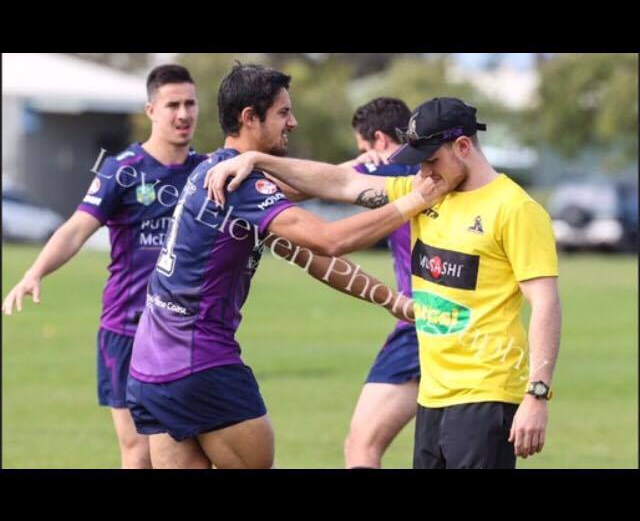
After a lengthy series of shoulder dislocations resulting in two surgeries as well as a total ankle reconstruction by the age of 19, it became abundantly clear that walking away from the game of rugby league was my best option. I was in my final year of an Exercise Science degree (2012) and the opportunity to become a Strength & Conditioning Coach for the Redcliffe Dolphins Cyril Connell & Mal Meninga rep sides arose (U/16s & U/18s for those unsure). I thought it was a wonderful segue that presented some direction for a seemingly directionless degree and I very much wanted to stay involved in the game I loved so dearly.
I experienced 2 grand finals that season, winning one and losing one before moving onto rival club Wynnum – Manly Seagulls Reserve Grade for 3 seasons. My time there yielded another 2 grand final appearances. You’re probably starting to think, wow this blokes tooting his own horn a bit. It’s the players who put in the hard yards to actually achieve these results. But being involved in this success was something I never really experienced as a player. I always played at a fairly mediocre level and was a big fish in a small pond. Being involved at a higher standard even as a coach, I started to build this identity of significance. My role became valued. Strength & Conditioning coaches didn’t even exist at a sub-elite level 5 years prior. Now it was mandatory to have one for every grade! I rode that wave on a social level too. All my mates were always keen to hear all the latest news and there was always a sense of envy that I was “doing what I love and got paid for it”.
All of this social feedback only reaffirmed that I wanted to make this a priority. That I would one day become an NRL Strength & Conditioning Coach. At the end of my 4th season as a coach, I was staring down the barrel of yet another season as a Reserves coach and after 2 grand finals I felt I deserved a promotion. But it didn’t seem likely so I put some feelers out and I got the opportunity to go back to Redcliffe. It ended up being the same role but after the first night of pre-season the Rehab Coach defected to Wynnum and I was offered the Rehab role (of the whole senior club). I took on the challenge and learnt a lot of new skills as well as standardised timelines of return to play protocols for various injuries. For the first time in just over 4 years I felt like I had true autonomy in my role and I was learning from someone who had experience in the role I wanted (Tony Guilfoyle was formerly at the Brisbane Broncos and since coming back to Redcliffe has now returned to the NRL with the Penrith Panthers). This was the increase in responsibility I was looking for and I now had much more contact with Queensland Cup level players. Again adding weight to the significance I felt with my coaching identity.
If being part of a staff for a team that went on to be Grand Finalists wasn’t enough, just 5 months after returning to Redcliffe I received a phone call from “Trigger” (Craig Ingebrigtsen) who was a development coach of mine as a kid who was now the Sunshine Coast Falcons Head Coach and Operations Manager for the Melbourne Storm NYC (U/20’s). He asked me what the terms of my contract were with Redcliffe and if I was interested in coming on as Strength & Conditioning Coach for the Storm side. You mean coach in an NRL system? One step away from my primary goal? I called Grant “Crusher” Cleal our Football Manager at Redcliffe and explained the opportunity. To his credit he was stoked for me and let me move on a weeks’ notice. Later that week I travelled up the coast (the Storm program had been relocated to the Sunshine Coast from Melbourne) for what I thought was just a meeting with the coach. But upon arrival I’m sitting with Trigger and he says “Mate, I think you’re a shoe in for the job, but we’ve got a few other blokes applying and Smithy (Eric Smith – Coach) just wants to tick a few boxes to be sure.” Keep in mind I’ve already quit Redcliffe and told them I got the job!!! It’s fair to say I’d never been shitting myself more than during that entire conversation with Smithy. Nevertheless, a few days later I was appointed at the Storm.
What got me pumped after taking on the Storm role was the sense of progression I’d gotten out of the narrative I was telling myself: you’re becoming a professional coach. Whilst I was still at Wynnum I remember having conversations via email with Lee Hopkins, Strength & Conditioning Coach at the Penrith Panthers. I was asking for some advice on progressing in the field. He was really responsive and some of the detail he gave about their protocols were extremely insightful. Yet I’ll never forget the fuel the following comment gave to my fire in becoming an NRL S&C coach. He said you’ve got to remember there’s only 16 clubs, depending on budget there’s room for 2-4 S&C staff. So take the averages and that‘s about 48 roles tops in the field you want to crack. That’s not easy! Well, the optimist in me thought “Fuck I hope everyone pushing for these roles is scared of those stats!” I wasn’t at all. In fact, my thinking went to the number of NRL players playing each year (approximately 400). So, that means it’s about 8x harder to become an S&C Coach than it is a player (statistically)! I’d never been more set in my ways after reading that email.
What changed? Well, I learnt a lot about myself at the Storm. I was finally in complete control of the prescription and implementation of an entire program. I could experiment with different protocols for certain positions, sizes etc. load management and recovery, it was great! But by seasons end I had a pretty powerful conversation with myself. I envisaged getting a call from Craig Bellamy, informing me I’d just been appointed Strength Coach at the Storm. I’d done it, I’d proved anyone who doubted me wrong. What now?…What now?…What do you mean what now? You’ve done it! But it was that response and the emptiness that came with it that made me realise I’d bullshitted myself. That the cool stories I got to tell my mates every 6 months when I finally got to see them outside of a packed schedule amounted to sweet f.a. That I felt I could provide something of greater depth rather than width. That the epidemic of suicide and depression evident in the rugby league community could be prevented. It was conversations I’d had with players over the years which planted seeds along the way to eventually reveal this elaborate web of ideas that I wanted to execute on. Notice the innocuous nature of the word conversation. Something so meaningless can hold such weight. It is this that I love most about rugby league circles. The conversation and how it can influence action. I won’t delve any deeper into what I’ve gravitated towards since leaving Rugby League S&C but something I said that resonated with a bloke now back in the NRL goes as follows. “I’d much rather see you succeed as a person than a footballer, any day of the week.”
Before finishing this blog I’m glad I stumbled upon this section of Yuval Noah Harari’s latest book “Homo Deus” and the notion of self and significance. He positions the two frames of identity that we operate through to evolve ourselves; the narrative-self and experiential-self. To use the example given in the book by Harari, look at how a soldier who lost his leg in battle would’ve reacted in the moment to that event. It’s absolutely horrific, the pain immense, and the uncertainty around death, crippling. This is the experiential-self, the real-time self. The narrative self is the now deformed soldier who is paraded around his home country being championed for protecting the security of his homeland. He now believes his sacrifice outweighs the pain and suffering encountered initially, a story, a narrative. When have you altered your actual experience to create a narrative that justifies your sacrifice? I’m positive we all have. It’s a coping mechanism to some extent. What I learnt about my narrative was that it didn’t really serve anyone else, or anyone long term. It was built to serve my ego, to say fuck you! Look at me! But at the core of my role as an S&C coach, it was my responsibility to help athletes physically. I still love doing that and continue to do so in my own business. But what drives me more is the psychology. How can you marry those two for all round human performance? Not athletic performance. More like..You-performance.
That in a nutshell is my current endeavour. One conversation at a time…
 Life as Benny